The members of the so-called “Prior-Hamblin school” weren’t a school at all. Colleagues? Competitors? We still barely know. The five usual suspects - W.M. Prior, S.J. Hamblin, G.G. Hartwell, W W. Kennedy, and E.W. Blake - are constantly compared, mixed up, and conflated. However, despite their profound similarities, they all had their own quirks - especially when it comes to a pair of eyes. Part 1 of this post will address, illustrate, and explain the PHS's five unique methods for the so-called windows to the soul. The PHS problem has been tackled by exceptional folk art scholars for generations before me, so I don't expect this post to solve it. However, I hope that it will offer some useful clues. Read on for the Eyes of the Prior-Hamblins. - - -
Unsolved cases are the gift that keeps on giving. Usually, that gift is frustration. Such is the case for even the most high-profile research projects, like the first episode of Fake or Fortune Series 13, “ The Mystery of Churchill’s Garden. ” More information must be out there - but where? Perhaps there’s a few more hints. Among them: a darker side to Claude Lowther; a clue in the underpainting; and proof that not every Churchill book can be trusted. - - - PART 1: Lowther’s Lambs to the Slaughter
In which a few intriguing social media discoveries are a good excuse to write about long-forgotten favorites. ( Daniel G. Lamont ) / ( Margaret B. Doyle ) / ( Otis Hovey ) - - - DANIEL G. LAMONT (1817-1883) My initial foray into the Facebook antiques world was marked by the emergence of this curious and unique pair of portraits (Fig. 1). Shared to the “Early American” Facebook group on August 7, 2025 by an individual seeking more information about her mother’s collection, the style immediately struck me as familiar. I re-posted them as an open question, then quickly edited it once the answer occurred to me: Daniel G. Lamont. The more I looked at the portraits, the more I was convinced. They have a striking likeness to the portraits of Abby Weare Stone and Charles James Fox Stone (Fig. 2), a signed 1851 pair .
One of the most vexing questions of the Prior-Hamblin School is how to tell five artistic hands apart. Now we have six. Recent research has revealed there's a particular version of the “flat style” face that doesn’t conform to any of the five known and documented Prior-Hamblins. After compiling and comparing many dozens of paintings, it has become obvious: we have a new artist on the horizon. Many thanks to Dr. Paul D'Ambrosio of Fenimore Museum for proposing that there is another unknown painter! I had gathered together a compilation, but was uncertain what to make of it. I consider this an incredibly exciting development. Like the rest, this artist paints highly distinctive eyes, which can serve as an attribution guide. Read on for the Eyes of the Sixth Prior-Hamblin. - - -
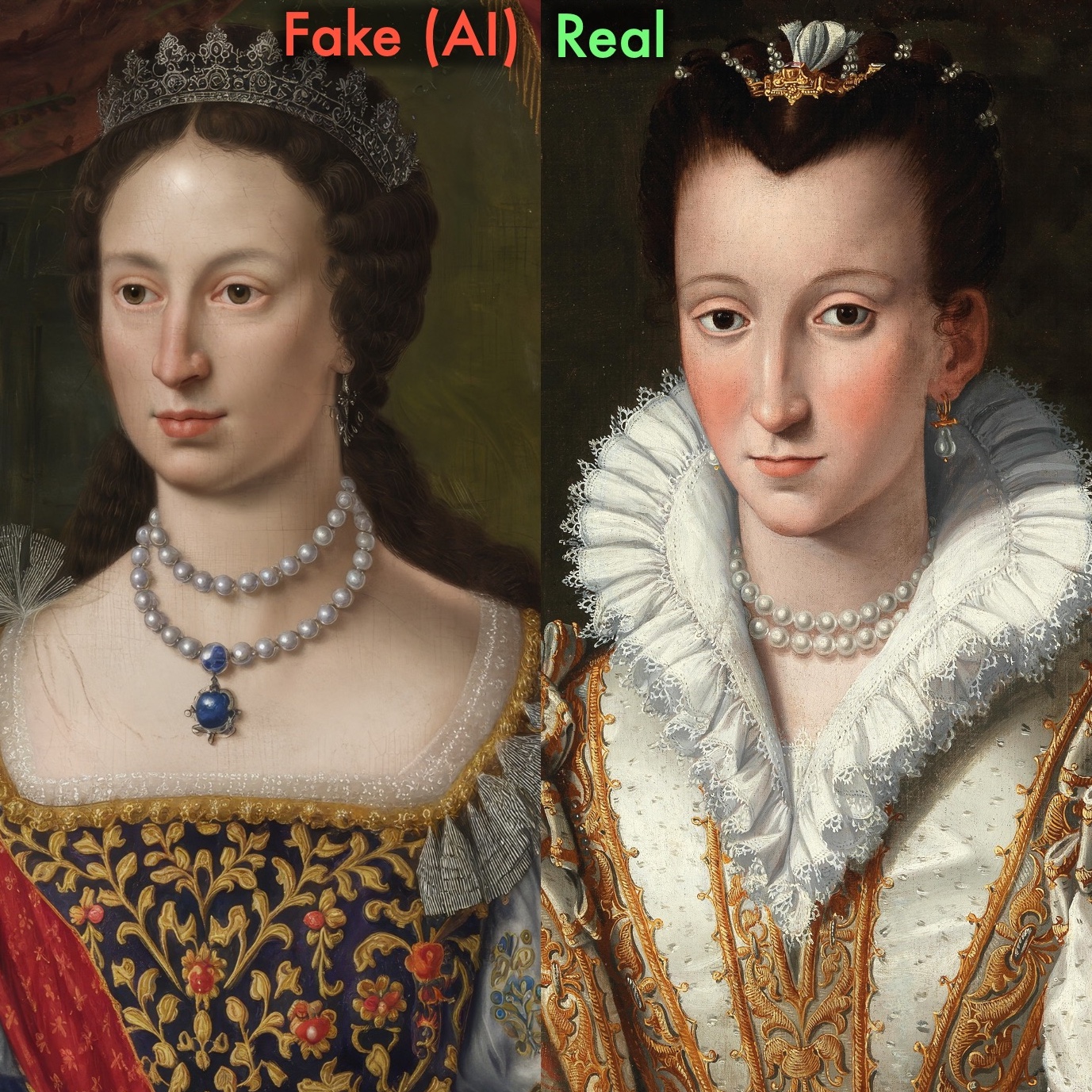
One might be forgiven for assuming that the onslaught of low-quality images generated by AI, littering social media like a graveyard, has not affected real painting scholarship. Unfortunately, that is not entirely true. Certain types of AI styles are good enough to fool the unwary. They occasionally pop up in art history discussion groups online. I’ve even had personal encounters with these fakes myself. In the interest of a warning, and a word to the wise, here’s some pointers on how to spot them.


Comments
Post a Comment